A 10-minute yoga practice for a stressful day

When the day feels too full, ten slow minutes on the mat can help you find a calmer pace. Here is a simple, breath-led practice.
Some days arrive already crowded. Your shoulders are near your ears by mid-morning, your breath is shallow, and the idea of a full workout feels like one more demand. On days like that, a short and gentle practice is often more useful than an ambitious one.
This 10-minute sequence is built around one idea: slow the breath first, and let the movement follow. It will not fix what is making the day hard. But many people find that a few minutes of slow breathing and simple movement helps them return to the rest of the day a little steadier.
Why the exhale matters
When you are stressed, breathing tends to get quick and high in the chest. Gently lengthening the exhale is one of the simplest ways to change that pattern. A common approach is to breathe in for a count of four and out for a count of six.
You do not need to force it. If the counts feel strained, shorten them until the breath feels easy. In this practice, breath comes first, and the poses are there to support it.
You can use this breath almost anywhere: on a train, before a meeting, or lying in bed. The poses below simply give it a slower rhythm to follow, and give your body something gentle to do while your mind catches up.
The 10-minute practice
- Minute one: sit cross-legged or on a chair. Rest your hands on your belly and take ten slow breaths with a longer exhale.
- Minutes two and three: come to hands and knees for cat-cow. Let each movement take a full breath.
- Minutes four and five: rest in child's pose with your forehead supported. Feel the breath move into your back.
- Minute six: thread the needle on each side to release the upper back and shoulders.
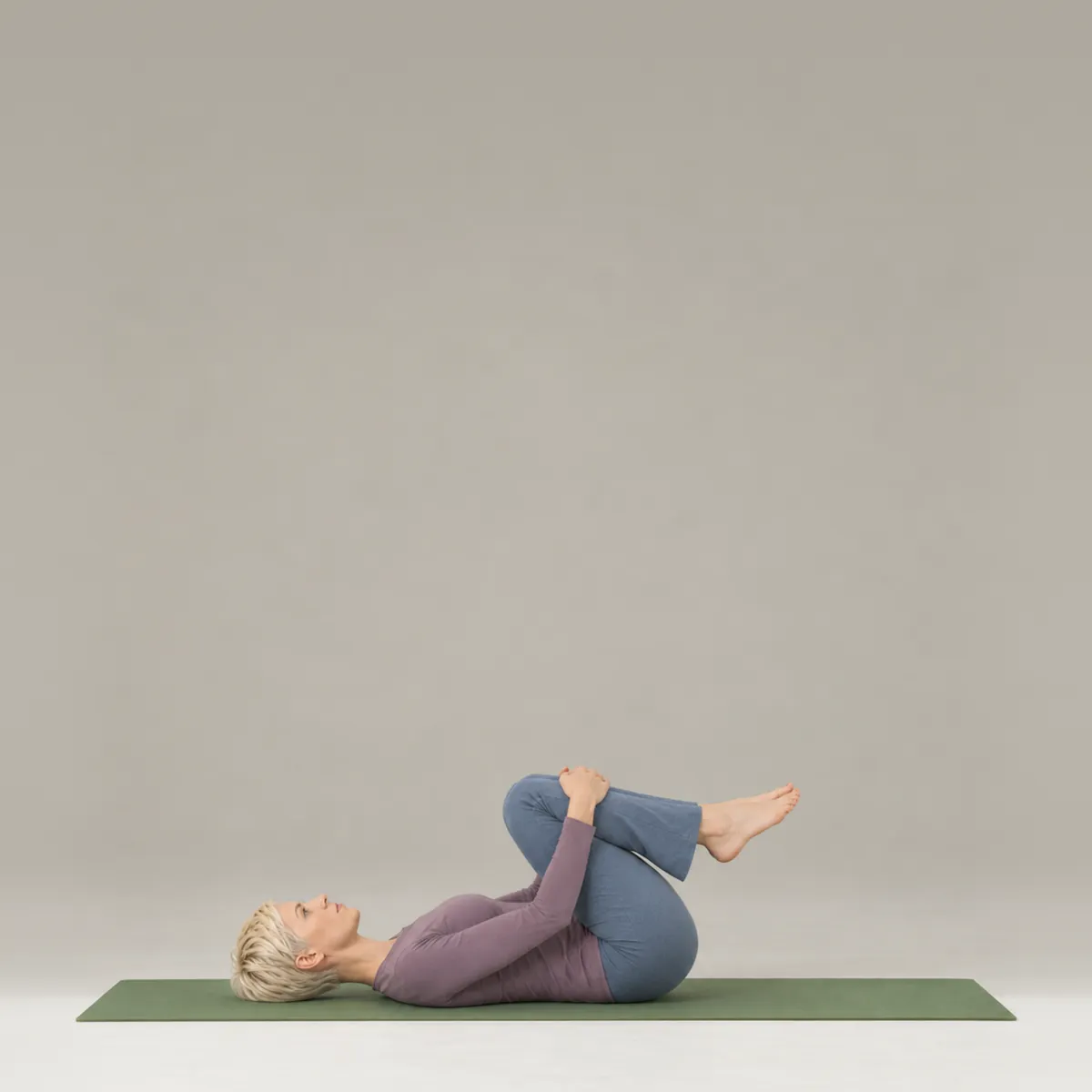
- Minute seven: lie down and hug your knees to your chest, rocking gently side to side.
- Minute eight: a supine twist, letting both knees fall to one side, then the other.
- Minutes nine and ten: legs up the wall, or simply lie flat, breathing slowly with your eyes closed.
Move slowly enough that you could talk if you needed to. This is not the moment to work on depth or strength. If any position feels uncomfortable, stay in child's pose or lie on your back instead.
Making it work on a real day
The hardest part of a stress practice is starting it. A few things help: keep your mat unrolled somewhere you will see it, decide in advance that ten minutes counts as enough, and let yourself practice in whatever you are wearing. On especially full days, the first minute of breathing on its own is a complete practice.
You can also split it up. Two minutes of slow breathing at your desk and the floor sequence in the evening still add up. If your shoulders and neck carry most of your tension, the poses in yoga for neck and shoulder tension pair well with this sequence. For evenings, a longer wind-down routine can ease the transition to sleep.
What yoga can and cannot do for stress
Yoga is not a treatment for anxiety, depression, or any other mental health condition. It can be one helpful part of looking after yourself, alongside sleep, movement, time with people you trust, and professional support when you need it.
If stress feels persistent or overwhelming, or is affecting your sleep, work, or relationships, please talk to a doctor or a mental health professional. If you ever feel unsafe, contact your local emergency services or a crisis line.
Be gentle with breathing exercises too. If slow breathing makes you feel lightheaded or more anxious, return to your natural breath. That is a normal response for some people, not a failure.
Where Kova helps
On a stressful day, the last thing you need is another decision. Kova remembers how your recent sessions felt and adapts the next one, so a hard week can lead to gentler practices without you having to plan them. Calm spoken cues guide your pace and breath.
If you use the camera, pose tracking runs entirely on your iPhone or iPad and your camera feed is never uploaded or stored. You can also leave the camera off and practice in audio-only mode.
You do not have to fix the whole day. You only have to make the next breath a little slower.
Questions this guide answers
Can yoga help with stress?
Many people find that slow, breath-focused yoga helps them feel calmer in the moment. It is not a treatment for anxiety or other conditions, so talk to a professional if stress is persistent or overwhelming.
What type of yoga is best for stress?
Gentle, slow practices with longer holds and an emphasis on breathing tend to feel most calming. Save intense flows for days when you have more energy.
How long should a yoga session for stress be?
Even five to ten minutes can help many people feel calmer. A short practice you actually do is more useful than a long one you keep putting off.
A coach that sees you move.
Pre-order Kova on the App Store. It downloads automatically on release day, and your first practice is free.