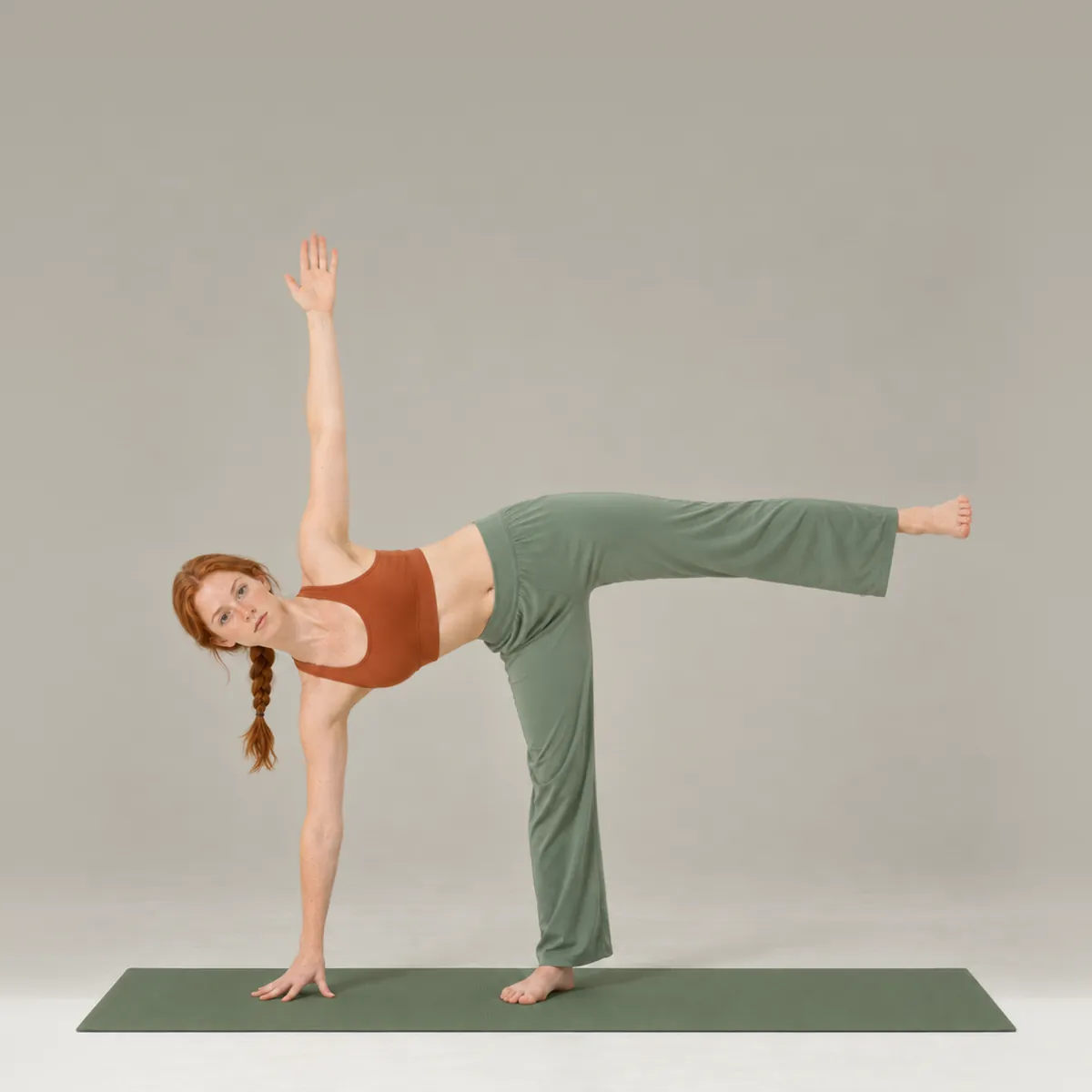
Warrior II form: a checklist from feet to fingertips

It looks simple. Then you hold it for five breaths. Here's how to build it from the ground up.
Warrior II is one of the most recognizable poses in yoga: a wide stance, front knee bent, arms stretched long in opposite directions. It builds strength in the legs, opens the hips, and asks for steady focus. It is also a pose where small misalignments add up quickly.
The best way to learn it is from the ground up. Each part of the pose sets up the next, so fixing the feet often fixes the knee, and fixing the knee often fixes the hips.
The checklist
- Feet: a wide stance, front toes pointing forward, back foot turned in slightly, front heel roughly in line with the back arch.
- Front knee: bent toward 90 degrees and tracking over the middle toes, not collapsing inward.
- Back leg: straight and strong, pressing through the outer edge of the back foot.
- Hips: opened toward the long side of the mat, as far as feels comfortable.
- Torso: stacked over the hips, not leaning toward the front leg.
- Shoulders: relaxed down and away from the ears.
- Arms: reaching long at shoulder height, palms facing down.
- Gaze: soft, over the front fingertips.
You do not need to perfect all eight at once. Pick one to focus on each time you practice the pose.
The most common mistake: the collapsing knee
If one thing goes wrong in Warrior II, it is usually the front knee drifting inward toward the big toe side. It often happens as the legs fatigue, and over time that pattern loads the knee in a way it does not love.
The fix starts at the foot. Press through the outer edge of the front foot and gently guide the knee toward your little toe. If the knee still collapses, shorten the stance and bend a little less. A smaller, well-aligned pose is better than a deep one that strains.
Other details worth watching
Leaning the torso toward the front knee is common, especially when trying to bend deeper. Draw your torso back until it is centered between your legs. Shoulders tend to creep up as the arms tire, so every few breaths, soften them down. And check your back leg: if it has gone soft and bent, press it straight.
Why alignment cues need good timing
Most of these mistakes happen mid-hold, as fatigue builds. A cue at the start of the pose cannot catch them. That is why following a video often leaves the problem unnoticed: the instructor is cueing the ideal shape, not responding to yours.
Kova is designed to catch these moments. On-device pose tracking reads the relationship between your hip, knee, and ankle as you hold Warrior II, and if your knee starts to drift, you hear a calm cue to guide it back toward your little toe. A live form score shows how the pose is coming together, and a "Not sure?" demo is there whenever a cue does not land.
Build strength gradually
Start by holding Warrior II for three to five breaths on each side. As your legs get stronger and the alignment feels natural, extend to eight or ten breaths. Steady breath is the signal you are ready for more.
Strength in Warrior II comes from staying aligned, not from sinking lower.
Questions this guide answers
Where should my front knee be in Warrior II?
Bent toward 90 degrees and tracking over the middle toes. It should not collapse inward or move far past the ankle.
Why does Warrior II make my legs shake?
Shaking usually means the muscles are working hard, which is normal while strength builds. Shorten the hold or the stance if the shaking makes your alignment slip.
Should my hips face the side or the front in Warrior II?
Traditionally the hips open toward the long side of the mat. Open them as far as feels comfortable without forcing the knee out of line.
A coach that sees you move.
Pre-order Kova on the App Store. It downloads automatically on release day, and your first practice is free.